Quick Answer
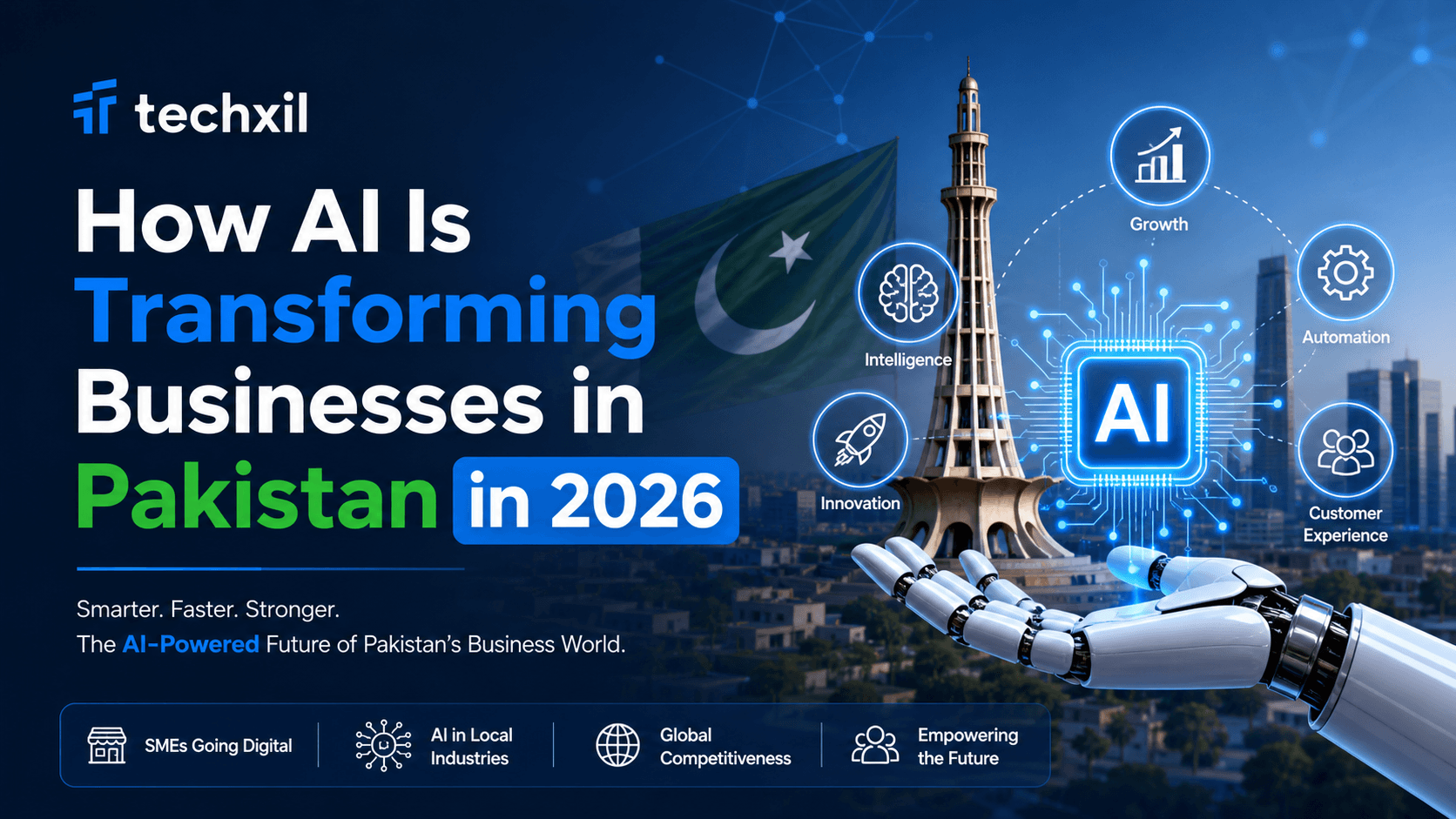
AI is transforming Pakistani businesses in 2026 through chatbots reducing customer service costs by 40–60%, predictive analytics improving inventory by 25–35%, and automation cutting repetitive task time by 50–80%. Sectors leading adoption: fintech, e-commerce, healthcare, and manufacturing.
The AI Revolution in Pakistan's Business Landscape
Pakistan's business ecosystem is experiencing a profound shift. With internet penetration exceeding 60%, a young tech-savvy workforce, and increasing smartphone adoption, the conditions for AI-driven transformation have never been more favourable. In 2026, AI is no longer a luxury reserved for global tech giants — it is a practical competitive advantage accessible to Pakistani SMEs and enterprises alike.
Government initiatives, including the National AI Policy and Ignite-funded AI startups, have accelerated adoption. Meanwhile, the availability of affordable AI tools like ChatGPT, Google Gemini, and local custom solutions has lowered the entry barrier significantly. Pakistani businesses that embrace AI today are positioning themselves to dominate their sectors for the next decade.
How Pakistani Businesses Are Using AI Today
Across five key sectors, AI adoption is creating measurable value for Pakistani businesses:
1. FinTech
Pakistani fintech companies are using AI for fraud detection, credit scoring, and customer onboarding. AI-powered KYC (Know Your Customer) systems have reduced onboarding time from days to minutes. Companies like Easypaisa and JazzCash use machine learning to flag suspicious transactions in real time, reducing fraud losses by up to 35%.
2. E-Commerce & Retail
E-commerce platforms are deploying AI for personalised product recommendations, dynamic pricing, and demand forecasting. AI-driven recommendation engines increase average order value by 15–25%. Inventory AI tools help retailers reduce stockouts by 30% while cutting overstock costs by 20%.
3. Healthcare
Healthcare providers across Karachi, Lahore, and Islamabad are adopting AI for diagnostic assistance, appointment scheduling, and patient record management. AI-assisted radiology tools are helping doctors process imaging 3x faster, while AI chatbots handle initial patient triage — freeing doctors for complex cases.
4. Manufacturing
Pakistan's textile and manufacturing sectors — the backbone of its export economy — are using AI for predictive maintenance, quality control, and supply chain optimisation. AI-powered visual inspection systems detect defects with 99.2% accuracy, dramatically reducing waste and rework costs in garment manufacturing.
5. Education
EdTech platforms in Pakistan are leveraging AI for personalised learning paths, automated grading, and intelligent tutoring systems. AI-powered platforms adapt content difficulty based on student performance, improving learning outcomes by 20–30% compared to traditional one-size-fits-all approaches.
Real Cost Savings from AI Automation in Pakistan
The financial case for AI adoption in Pakistan is compelling. Here is what Pakistani businesses are achieving:
- Customer service: AI chatbots handle 60–70% of routine queries, reducing customer support costs by 40–60% while maintaining 24/7 availability.
- Data entry and processing: Robotic Process Automation (RPA) eliminates manual data entry, cutting processing time by 80% and error rates by 95%.
- Marketing and content: AI-generated personalised email campaigns achieve 35% higher open rates and 22% higher click-through rates than generic campaigns.
- HR and recruitment: AI-powered CV screening reduces time-to-hire by 50% and eliminates unconscious bias from initial candidate filtering.
- Financial reporting: Automated financial analysis tools that once required a full analyst team can now be operated by a single person using AI, reducing operational costs by 60–70%.
AI Tools Pakistani Businesses Are Adopting Right Now
The AI tool landscape available to Pakistani businesses in 2026 is richer than ever:
- ChatGPT (OpenAI): Used for content creation, customer support drafting, code assistance, and business analysis. ChatGPT Enterprise is seeing rapid adoption among Pakistani corporations.
- Google Gemini: Integrated into Google Workspace, enabling AI assistance across Gmail, Docs, Sheets, and Meet — with particular appeal for SMEs already using Google's ecosystem.
- Microsoft Copilot: Embedded in Microsoft 365, Copilot is transforming how Pakistani enterprises handle documentation, spreadsheets, and presentations.
- Custom AI Chatbots: Built on GPT-4 or Claude APIs, these domain-specific chatbots handle industry-specific queries (legal, medical, financial) with far greater accuracy than general-purpose tools.
- Predictive Analytics Platforms: Tools like Tableau AI, Power BI Copilot, and custom-built platforms help Pakistani businesses forecast sales, manage inventory, and identify churn risks.
Challenges Pakistani Businesses Face with AI Adoption
Despite the clear benefits, AI adoption in Pakistan is not without obstacles:
- Cost barriers: Initial implementation costs can be prohibitive for small businesses. Custom AI solutions require investment in data preparation, development, and infrastructure — often PKR 500,000 or more.
- Talent gap: Pakistan faces a significant shortage of AI engineers, data scientists, and ML specialists. This drives up salaries and makes it harder for companies to build in-house AI capabilities.
- Data quality issues: Many Pakistani businesses lack clean, structured historical data — the foundation of effective machine learning. Poor data quality leads to inaccurate AI outputs and erodes trust.
- Cultural resistance: Employees fear job displacement and often resist AI tools. Successful adoption requires change management, transparent communication, and retraining programs.
How to Start with AI in Your Pakistani Business
A phased, pragmatic approach yields the best results for Pakistani businesses entering the AI space:
- Assess your readiness: Audit your existing data, processes, and technology infrastructure. Identify where manual effort is highest and where data is most abundant.
- Identify the right use case: Start with one high-impact, well-defined problem — such as automating customer support or forecasting inventory demand.
- Start small and iterate: Build or deploy a focused AI solution. Measure results rigorously for 60–90 days before expanding scope.
- Measure ROI clearly: Define success metrics upfront — cost reduction, time saved, revenue generated. AI projects without clear KPIs rarely deliver lasting value.
- Scale what works: Once you have proven ROI on one use case, expand systematically to adjacent problems across your business.
Frequently Asked Questions
How much does AI implementation cost for a Pakistani business?
AI implementation costs vary widely. Basic chatbot solutions start from PKR 150,000–500,000. Custom AI automation systems with machine learning components range from PKR 500,000 to PKR 3,000,000+, depending on complexity, data requirements, and integration scope.
Which types of businesses benefit most from AI in Pakistan?
FinTech, e-commerce, healthcare, and manufacturing businesses see the highest ROI. Any business with high-volume repetitive tasks, large customer service loads, or data-intensive operations benefits significantly from AI adoption.
How long does it take to implement AI in a Pakistani business?
A basic AI chatbot deployment takes 2–4 weeks. A full AI automation system with custom ML models typically requires 3–6 months. Timeline depends on data readiness, complexity, and integration requirements.
What are the risks of AI adoption for Pakistani businesses?
Key risks include data quality issues, talent shortages, cultural resistance, and regulatory uncertainty in regulated sectors. Starting with a small pilot project significantly reduces these risks by limiting initial investment and allowing for learning before full-scale deployment.
AI is not coming to Pakistani businesses — it is already here, reshaping competitive dynamics across every major sector. The question is no longer whether to adopt AI, but how quickly and how strategically. Techxil specialises in building custom AI automation solutions for Pakistani businesses — from intelligent chatbots to full-scale ML platforms. Explore our AI services or get in touch to discuss your AI transformation journey.